Rotary Piling for Deep Foundations
Rotary piling uses a hydraulic rotary rig and telescopic kelly bar to drill large-diameter bored piles cleanly and with low vibration. Next Gen Construction runs rotary rigs for bridges, high-rises and industrial projects across Bangladesh, drilling beyond 50m where the design calls for it.
Rotary piling is a bored piling method in which a hydraulic rotary rig turns a drilling bucket or auger on a telescopic kelly bar to excavate the pile bore, which is then reinforced and concreted by tremie. Next Gen Construction offers rotary piling in Bangladesh for large-diameter, deep piles on bridges, high-rise buildings and industrial sites.
রোটারি পাইলিং কী?
রোটারি পাইলিং হলো বোর্ড পাইলিংয়ের একটি পদ্ধতি, যেখানে হাইড্রোলিক রোটারি রিগ টেলিস্কোপিক কেলি বারের মাথায় লাগানো ড্রিলিং বাকেট বা অগার ঘুরিয়ে পাইলের গর্ত খনন করে, তারপর রিবার কেজ বসিয়ে ট্রেমি পাইপে কংক্রিট ঢালাই করা হয়। Next Gen Construction বাংলাদেশে ব্রিজ, উঁচু ভবন ও শিল্প প্রকল্পের জন্য বড় ব্যাসের গভীর রোটারি পাইলিং করে।
Advanced Rotary Piling Services for Deep Foundation Projects
Rotary piling is a preferred method for large-diameter, high-capacity bored piles. A hydraulic rotary rig drives a telescopic kelly bar that carries a drilling bucket, auger or core barrel. The tool cuts and collects soil, is lifted out, emptied and lowered again, cycle after cycle, until the bore reaches founding level. Temporary casing, often installed by the rig itself, supports the top of the hole, and bentonite or polymer fluid stabilises it below.
Next Gen Construction operates heavy-duty hydraulic rotary rigs as part of its own fleet. Because the rig controls verticality and depth from the cab, bores tend to be straight and consistent, and the bucket removes soil in controlled bites with little disturbance to surrounding ground. This makes rotary piling a good fit where columns carry heavy loads and the design needs bigger, deeper piles than a tripod rig can practically drill.
Where does your pile end underground?
Drag the slider to push the pile down and see which soil layer it reaches.
A typical Dhaka-region profile — your own soil test (SPT) report decides the real pile length.
High-Capacity Rotary Piling Construction for Bridges and High-Rise Buildings
Our rotary piling work is aimed at efficient penetration through the dense sand and stiff clay layers that lie beneath the soft surface soils in much of Bangladesh. Changing the tool lets the rig deal with different strata: augers for cohesive clay, buckets for sand below the water table, and rock or core tools where harder material such as weathered rock is present, as in parts of the Chattogram and Sylhet regions.
Bridge piers, flyovers, high-rise towers and power and industrial plants often need large-diameter piles taken deep into a competent bearing layer. Rotary bored piling makes that practical, and our rigs can drill beyond 50m where the design requires. Load-bearing performance depends on design, workmanship and testing together, so we follow BNBC and the specification, keep full pile records and carry out integrity and load tests as your engineer requires.
What you get with Next Gen
Large-diameter piles
Rotary rigs drill the big, deep bores that heavy columns, bridge piers and towers often need.
Faster per pile
Bucket and auger drilling removes soil quickly, so each pile usually takes less time than with a tripod rig.
Low vibration and noise
Drilling instead of chiselling keeps vibration low near occupied buildings, schools and hospitals.
Straight, controlled bores
Verticality and depth are monitored from the rig, giving consistent bores that match the design.
Handles hard strata
Interchangeable tools work through dense sand, stiff clay and, where present, weathered rock.
Cleaner base and site
Spoil comes out in the bucket and a cleaning bucket clears the base before the cage and concrete go in.
Our piling process, step by step
- 01
Design and rig selection
We review the pile schedule, loads and soil report, then confirm rig size, kelly length, tools and casing with your engineer.
- 02
Working platform
A firm, level working platform is prepared so the heavy rig can travel and drill safely and keep the mast vertical.
- 03
Casing and drilling
Temporary casing is set at the top, then the rig drills with bucket or auger on the kelly bar, using stabilising fluid below the water table.
- 04
Depth check and base cleaning
Founding level and soil are confirmed against the design, and a cleaning bucket removes loose material from the base.
- 05
Cage and tremie concrete
The rebar cage is lowered by crane and concrete is placed by tremie from the bottom up, keeping the pipe embedded in fresh concrete.
- 06
Casing removal and testing
Casing is withdrawn, pile heads are trimmed to sound concrete, and integrity or load tests are done as specified.
Efficient and Low-Noise Rotary Piling Contractor for Urban Sites
Choose rotary piling for faster execution and low vibration in urban construction zones. The rig drills rather than drops a heavy chisel, so ground vibration is low and the noise is mainly the engine and hydraulics. For sites surrounded by occupied buildings, hospitals or schools, that reduces disturbance and the risk of affecting neighbouring foundations. Spoil comes out in the bucket, so the site stays cleaner than with large volumes of wash water.
Careful equipment use supports smooth hole excavation and sound concrete placement. Before concreting, the base is cleaned with a cleaning bucket and the slurry is checked, then the rebar cage is lowered and concrete is placed by tremie from the bottom up. Rotary rigs do need a firm, level working platform and enough space to move, so on very tight plots we may advise tripod rigs or a mix of both.
Which piling method fits your project?
What are you building?
Old buildings right next to the site?
Do you have a soil report?
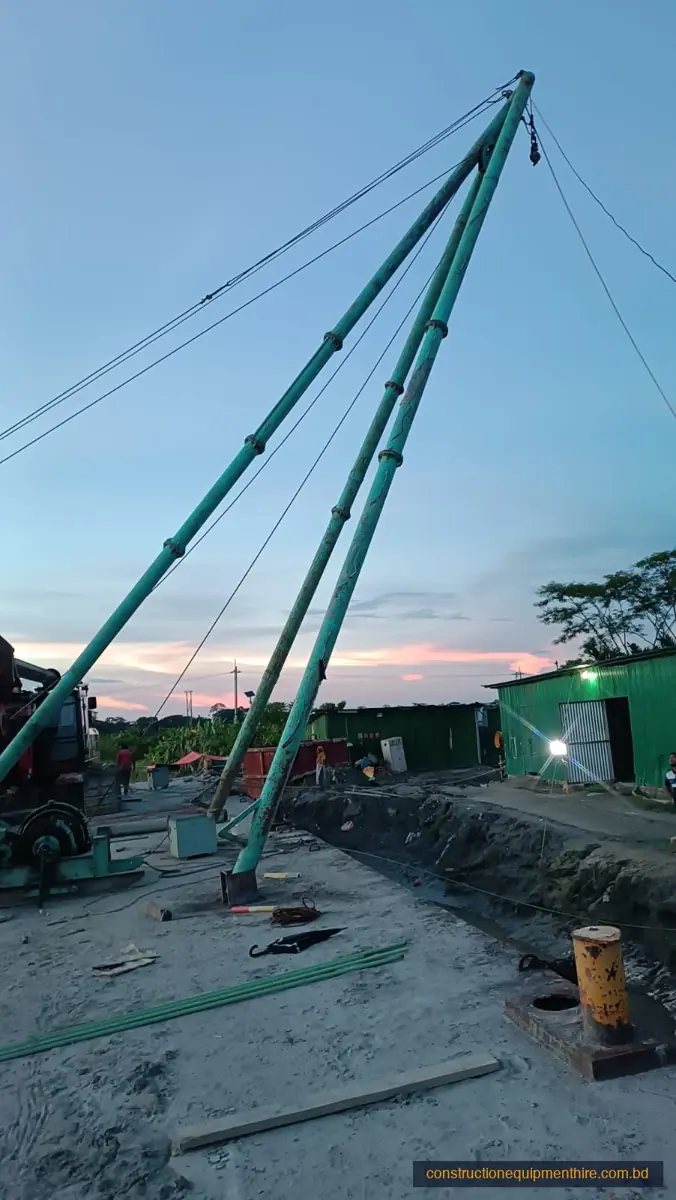
From our own piling sites
Rotary rig vs tripod percussion rig in Bangladesh
| Factor | Hydraulic rotary rig | Tripod percussion rig |
|---|---|---|
| Drilling method | Bucket or auger turned by kelly bar | Chisel and bailer, often with wash boring |
| Typical pile size | Large diameter and deep piles | Small to medium diameter piles |
| Speed per pile | Usually faster | Slower, more labour-intensive |
| Vibration and noise | Low vibration, engine noise | Repeated impacts, more vibration |
| Site needs | Firm platform, more space and access | Fits tight plots, light mobilisation |
Questions people ask
What is rotary piling?
Rotary piling is a way of drilling bored piles using a hydraulic rotary rig. The rig rotates a drilling tool on a telescopic kelly bar to cut and lift soil out of the bore. When founding level is reached, the base is cleaned, a rebar cage is installed and concrete is poured by tremie to form a cast in situ pile.
What is a kelly bar?
A kelly bar is the telescopic steel drill stem on a rotary rig. It has several nested sections that extend as the bore gets deeper and transmit torque and downward force from the rotary head to the bucket or auger. Friction and interlocking types exist; interlocking kelly bars can apply more down-force for hard layers.
Rotary piling vs tripod piling: which is better?
Neither is better for every job. Rotary rigs are generally faster, drill larger and deeper piles and cause less vibration, so they suit bridges, towers and big sites. Tripod percussion rigs, common in Bangladesh, need little space and are economical for small-diameter piles on tight residential plots. We recommend the method after reviewing your design and site.
Can rotary rigs drill through rock?
Yes, with the right tools. Most of Bangladesh is deep alluvial soil, but weathered rock or very dense layers occur in some areas, such as parts of the Chattogram and Sylhet regions. Rotary rigs can switch to rock augers or core barrels for these strata. Progress depends on rock strength and should be assessed from the soil investigation.
How long does rotary piling take?
It depends on the number of piles, their diameter and depth, the soil layers, the working platform and concrete supply. A rotary rig often completes a pile in less time than a tripod rig, but overall programme also depends on testing and site logistics. After seeing your drawings and soil report we can give a typical schedule, not a fixed promise.
How much does rotary piling cost in Bangladesh?
The price depends on pile diameter, depth, the soil report, the number of piles and site access, plus rig mobilisation and testing needs. We do not quote fixed rates without reviewing the project. Send your drawings and soil report for a free quotation, and we usually reply within 24 hours.
Is rotary piling suitable for small residential plots in Dhaka?
Sometimes. Rotary rigs need a firm working platform, room to manoeuvre and access for the rig and cranes. On very narrow plots a tripod rig may be the practical option. Where access allows, a rotary rig's low vibration is useful near neighbouring buildings. We visit or review the site layout before advising.
Explore our piling services
Planning large-diameter piles for your project?
Send your pile schedule and soil report. Our team will advise on rotary or tripod rigs and reply with a free quotation within 24 hours.
- +880 1784-222255
- eomsbd@gmail.com
- Ta-90/4, Link Road, Middle Badda, Gulshan-1, Dhaka
- Sat–Thu 8am–6pm · 24hr emergency line