Sheet Piling in Bangladesh for Earth Retention
Steel sheet piles form an interlocking wall that holds back soil and water while you excavate or protect a bank. Next Gen Construction drives sheet piles with vibratory hammers for basements, riverbanks, cofferdams and retaining walls across Bangladesh, as temporary shoring or permanent structures.
Sheet piling is the installation of interlocking steel sections driven into the ground to form a continuous wall that retains soil and limits water seepage. Next Gen Construction provides sheet piling in Bangladesh for basement excavation, riverbank protection, cofferdams and retaining walls, using vibratory hammers for driving and extraction of temporary walls.
শিট পাইলিং কী?
শিট পাইলিং হলো একটির সাথে আরেকটি আটকানো (ইন্টারলকিং) স্টিলের সেকশন মাটিতে ড্রাইভ করে একটি অবিচ্ছিন্ন দেয়াল তৈরি করা, যা মাটি ধরে রাখে এবং পানি চুইয়ে আসা কমায়। Next Gen Construction বাংলাদেশে বেসমেন্ট খনন, নদীতীর রক্ষা, কফারড্যাম ও রিটেইনিং ওয়ালের জন্য ভাইব্রেটরি হ্যামার দিয়ে শিট পাইলিং করে এবং অস্থায়ী দেয়ালের শিট পাইল তুলে আবার ব্যবহার করে।
Professional Sheet Piling in Bangladesh for Soil and Earth Retention
Sheet piling protects an excavation by forming a continuous steel wall before digging starts. Each sheet pile locks into the next along its edge, so the finished line resists both earth pressure and the flow of groundwater. In Bangladesh, where soft clay, loose sand and a high water table are normal, an unsupported cut can slump within hours, and seepage can wash soil from under neighbouring footings.
Next Gen Construction installs steel sheet piles for basement excavation, riverbank protection and retaining walls. The wall type, section size and length are set by your engineer from the soil report, the excavation depth and any loads behind the wall, such as an adjacent building or road. Depending on depth, the wall may work as a cantilever or need walers, struts or anchors, and we install these supports as the dig proceeds.
How deep can a sheet pile wall retain?
Drag the slider — the wall system changes with the excavation depth.
A general guide only — the real design comes from the soil report and the engineer’s calculations.
Durable Sheet Piling in Bangladesh for Deep Excavation Protection
We carry out both temporary and permanent sheet pile driving using vibratory hammers. A vibratory hammer clamps the top of the pile and vibrates it, which loosens the grip of the surrounding soil so the pile sinks under its own weight and the rig's force. This method works well in the silty sands and soft clays found across much of the country and is generally quicker and quieter than impact driving.
Temporary sheet piles hold the ground while basement walls and floors are built, then they are extracted with the same vibratory hammer and reused on other jobs, which keeps material use down. Permanent sheet piles stay in place as a retaining or bank wall and are specified with a suitable section and corrosion allowance or coating. Where hard layers resist driving, we discuss pre-augering or another method with the engineer.
What you get with Next Gen
Holds soil and water
Interlocking steel sections form a continuous wall that retains soil and limits groundwater seepage into the excavation.
Quick to install
Vibratory driving installs a wall quickly in soft and sandy soils, so excavation can start soon after mobilisation.
Temporary or permanent
Use sheet piles as shoring during construction or leave them as a permanent retaining or bank protection wall.
Extracted and reused
Temporary sheet piles are pulled out with the vibratory hammer after the work and reused, reducing steel waste.
Dry work in rivers
Cofferdams let water be pumped out so pier caps and intake structures are built in dry conditions.
Saves plot space
A thin vertical wall allows excavation close to the boundary instead of wide sloped cuts that waste land.
Our piling process, step by step
- 01
Site and soil assessment
We review the soil report, excavation depth, water levels and neighbouring structures, and agree sheet section, length and support system with your engineer.
- 02
Set out and guide frame
The wall line is marked and a guide frame or template is set up so the sheets go in straight and interlocks stay engaged.
- 03
Vibratory driving
Sheets are pitched by crane and driven with a vibratory hammer in panels, checking verticality and toe level as each pair goes down.
- 04
Install walers and struts
As excavation proceeds in stages, walers, struts or anchors are added at the levels shown in the design to control wall movement.
- 05
Excavate and control water
Soil is removed inside the wall and any seepage is pumped out. Interlocks and wall movement are inspected throughout the dig.
- 06
Extract or finish
After permanent works and backfill, temporary sheets are vibrated out and reused. Permanent walls are capped and finished as designed.
High-Quality Steel Sheet Piling in Bangladesh for Marine and Land Works
Our sheet piling services in Bangladesh provide earth retention for marine and river structures, cofferdams and deep basement foundations. A cofferdam is a closed ring of sheet piles that lets water inside be pumped out, so bridge pier caps, intake structures or pump houses can be built in dry conditions. For riverbanks and ghats, a sheet pile line can help stabilise the bank against erosion when designed with proper toe depth.
On land, sheet pile walls support basements for apartment and commercial buildings, utility trenches, pump stations and sewage tanks. In very tight Dhaka plots, vibration can still affect fragile neighbouring structures, so we assess adjacent buildings first and, where needed, monitor them or suggest a bored pile wall instead. Our own fleet of sheet piles, vibratory hammers and cranes lets us mobilise to sites nationwide.
Which piling method fits your project?
What are you building?
Old buildings right next to the site?
Do you have a soil report?
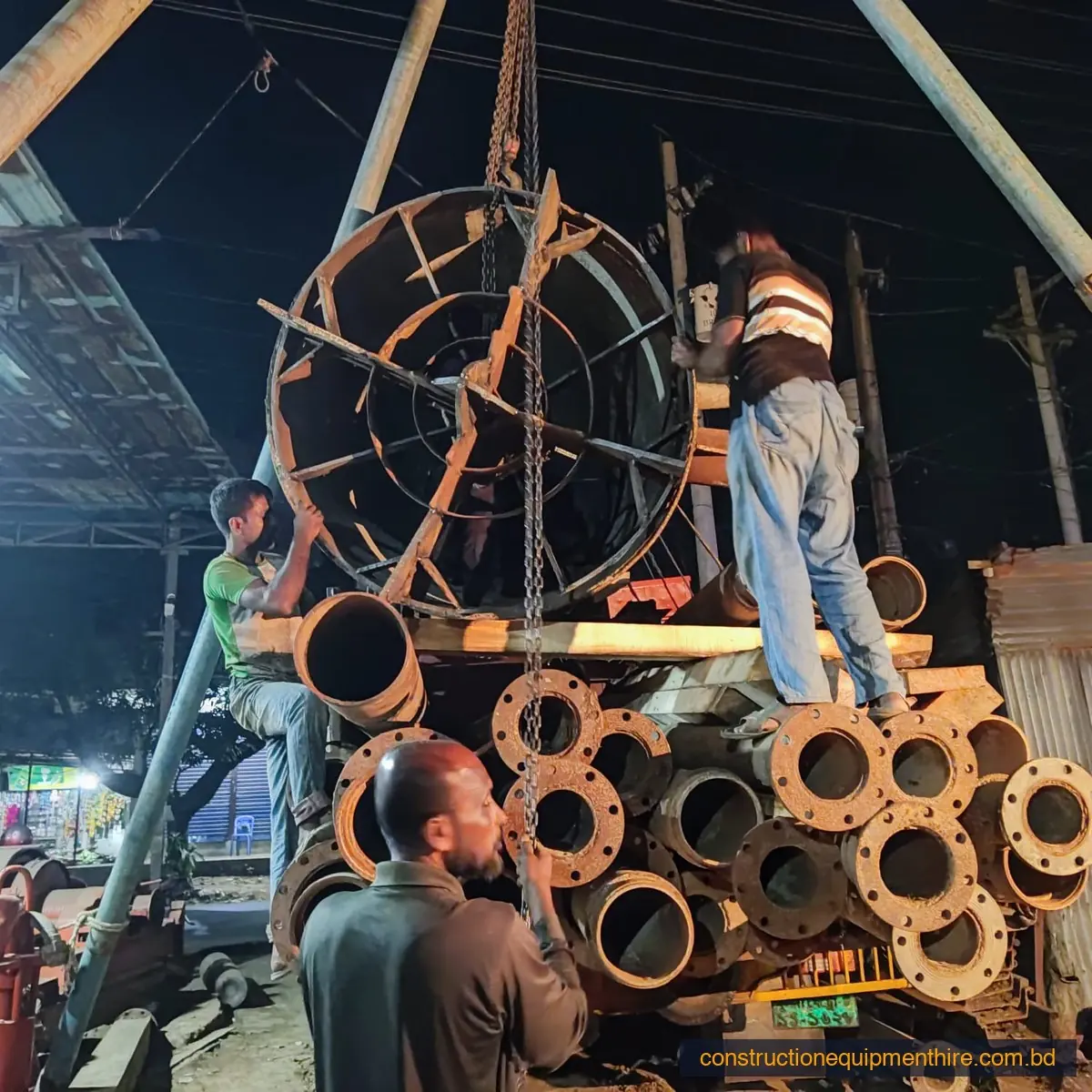
From our own piling sites
Steel sheet pile wall vs bored pile wall vs open cut
| Steel sheet pile wall | Bored pile wall | Open cut with slopes |
|---|---|---|
| Driven steel sections, quick to install in soft soil | Row of concrete bored piles, slower to build | No wall, soil sloped back |
| Low seepage through interlocks | Gaps between piles may need grouting | Seepage and slope collapse risk high |
| Can be extracted and reused if temporary | Permanent, stays in the ground | No material left, but needs backfill |
| Some vibration during driving | Very low vibration | No vibration, but large excavation |
| Uses little plot space | Uses little plot space | Needs wide land around the dig |
Questions people ask
What is sheet piling used for?
Sheet piling is used to retain soil and limit water inflow. Typical uses are shoring for basement excavations, riverbank and ghat protection, cofferdams for bridge piers and intake structures, retaining walls, and trench support for drains and pipelines. It can be a temporary wall removed after construction or a permanent structure left in place.
Can sheet piles be removed and reused?
Yes. Temporary sheet piles are extracted with a vibratory hammer once the basement walls or other permanent works are complete and backfill is in place. If they are not badly damaged they are reused on later projects. Extraction is planned carefully so that removing the sheets does not loosen soil under nearby footings.
How are sheet piles driven?
We use vibratory hammers mounted on a crane or excavator. The hammer grips the pile and vibrates it, reducing friction with the soil so the pile can be pushed down. This suits the soft clays and silty sands common in Bangladesh. In very dense or hard layers, pre-augering or impact driving may be needed, which we agree with the engineer.
Is sheet piling safe near existing buildings?
It can be, but it needs care. Vibratory driving causes some ground vibration, and very old or fragile buildings close by can be affected. We inspect neighbouring structures before starting, plan the driving sequence, and can monitor them during the work. Where risk is too high, a bored pile wall with lower vibration may be the better choice.
How long does sheet piling take?
It depends on the wall length, sheet length, soil conditions, any hard layers, the support system and site access for cranes. Driving is often the quicker part, while staged excavation and installing walers and struts take longer. After reviewing your drawings and soil report we can give a typical timeline for your site, but not a fixed promise.
How much does sheet piling cost in Bangladesh?
The price depends on wall length, sheet section and length, the soil report, whether the wall is temporary or permanent, support requirements and site access. We do not publish fixed rates. Send your drawings and soil report and we will prepare a free quotation for your project, usually replying within 24 hours.
What is a cofferdam?
A cofferdam is a temporary enclosure, often a ring of interlocking steel sheet piles, built in or beside water. Once sealed and braced, the water inside is pumped out so foundations, pier caps or intake structures can be built in dry conditions. After the work is finished, the sheet piles are usually extracted and the area returns to water.
Explore our piling services
Need sheet piling for a basement or riverbank?
Share your excavation drawings and soil report. We will review the wall design and reply with a free consultation and quotation within 24 hours.
- +880 1784-222255
- eomsbd@gmail.com
- Ta-90/4, Link Road, Middle Badda, Gulshan-1, Dhaka
- Sat–Thu 8am–6pm · 24hr emergency line